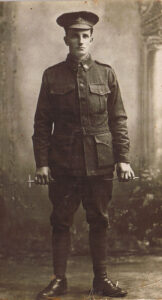
Roy Alexander Fregon
Private, 57th Battalion, Australian Imperial Force
Service No. 2410
1895 – 25 September 1917
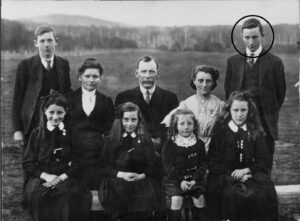
Roy Alexander Fregon was born in 1895 at Bruthen, Victoria, the son of John James Francis Fregon and Augustina Fregon (née Hoppner). He attended St Patrick’s College, Ballarat, from 1909 to 1911, alongside his younger brother, John ‘Jack’ Fregon.
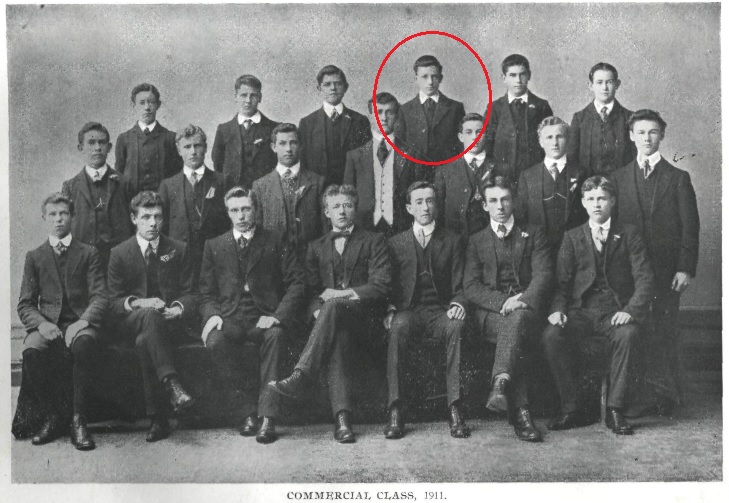
 At SPC, Roy was a capable and diligent student. In 1911, he was enrolled in the Commercial Class, finishing second overall in his examinations, with academic excellence in Arithmetic and British History. His elected special subject was Christian Doctrine. Outside the classroom, he showed promise in handball and athletics and was regarded as an enthusiastic and well-liked boy.
After leaving school, Roy worked as a farmer and grazier. He also served in the 71A Senior Cadets, demonstrating an early sense of duty. On 27 June 1916, aged 21 and unmarried, he enlisted in the Australian Imperial Force. At enlistment he was described as 5 feet 7½ inches tall, with a fresh complexion, blue eyes and black hair.
Roy departed Melbourne aboard HMAT Shropshire on 25 September 1916. As he left, he gave his younger brother Jack the end of a ball of string, telling him that as long as Jack held it, they would always be tied together. Jack treasured that piece of string for the rest of his life until his passing and is now held by a relative.
Roy disembarked at Plymouth on 10 November 1916 and reported the following day to the 15th Training Battalion at Woolwich. In letters home, he described his arrival in England with excitement and optimism, recounting submarine activity at sea, the bustle of a major naval base, and the warmth of the English countryside. He wrote warmly of the journey through Devon, Somerset and Dorset, and of the refreshments provided by civic dignitaries in Exeter, noting the men’s happiness and good spirits despite the long journey and looming danger.
 In January 1917, Roy embarked for France and proceeded to Étapes, where he was attached to the 57th Battalion on 20 January 1917. He saw active service on the Western Front and, on 13 May 1917, suffered a gunshot wound to the hand. He was admitted to the 32nd Stationary Hospital at Wimereux, then transferred to a convalescent hospital at Boulogne, where he remained until early July. On 3 July 1917, he rejoined his unit in the field.
Shortly after returning to duty, Roy received devastating news: his uncle Frank Fregon, who had been serving alongside him, had died. In a letter to his grandmother, Roy revealed the emotional cost of war and a noticeable shift in tone from his earlier, eager letters. He described helping tend Frank’s wound, a small but fatal injury and carrying him to the dressing station. Until then, Roy wrote, he, Frank and another relative had considered themselves “a lucky trio,” having escaped danger many times together.
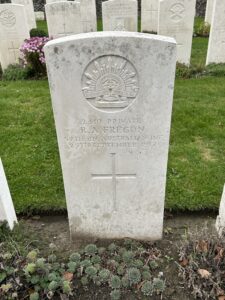
On 25 September 1917, Private Roy Alexander Fregon, aged just 22, was killed in action in Belgium. He was buried at Tyne Cot Military Cemetery, Passchendaele, West-Vlaanderen, Flanders, today the largest Commonwealth war cemetery in the world.
In early October 1917, Roy’s parents received a letter from his comrades in the 57th Battalion. They wrote of his “genuine and endearing disposition,” describing him as one of the very best of comrades, always cheerful, always brave, and ready to do his duty without fear. They spoke of plans once made to share holidays after the war, now left unfulfilled, and of the deep loss felt by all who had served alongside him.
The letter concluded with words that encapsulated both the grief and meaning attached to his sacrifice:
“Greater love had no man than this,
That he lay down his life for his friend.”
Roy Alexander Fregon is remembered as a devoted son and brother, a capable student, a valued comrade, and a young Australian who gave his life in service far from home.
Additional information
News Papers
In the Omeo Standard and Mining Gazette on Friday, 10 December 1915, Roy was listed as
“Those who are going”.
The Bruthen and Tambo Times reported on Thursday, 22 February 1917, in the column ‘Soldier’s Letters’,
Mr J.J. Fregon of Ensay received word on November 12 that Roy was in France, from Bovington Camp, Wareham, England. Roy writes,
After having a really good trip, we arrived in camp on Saturday night, 11th November. We were very lucky to get here as safe as we did. Submarines have been very busy about these parts, and it appears they were out to catch us. A ship sank within half an hour of where we were once, and ten more sank on our course. Needless to say, we heard nothing of this till we were safe in port.
It made us think, I can tell you, although we were always on alert; in fact, we were always ready for the alarm. We had to call at a French port on the way for protection against those “tin fish,” as they called them. Another transport with Australians on board that had left over a week earlier was there at the same time, as were other transports with soldiers going somewhere.
Nothing in particular happened on the voyage, besides passing a number of ships which we made sure of keeping clear from. The finals of the sports were settled, and we were all looking anxiously for the finish, as we were beginning to get fed up with the life.
As we neared England, things were looking very business‑like — destroyers racing in every direction, as it was about here that submarines were dangerous. We got into port, but the worst luck, it was dark. This is the main English naval base, so things are very busy here. As soon as we got through the heads, searchlights were turned on in all directions.
Orders were passed round to get ready to disembark. Tea early, kits packed and ready, as well as rations given out, bully beef and biscuits, rations for 24 hours. After a good deal of bustle, orders came out that we were not disembarking that night. We slept in our clothes for the night, a common occurrence in the army.
Next morning, all excitement. We were up and doing long before light. It was a great sight. As the darkness cleared, we could see the outlines of boats all around us, and in the light was a big bay as busy as could be, with boats of all classes, including destroyers racing here and there.
We disembarked about 8 a.m. on Saturday. This had to be done by smaller boats called tenders. It took four of these, and on the first, we had a look and got a surprise. We were all together — Les Nicholson, Bob Clues, Fred Burt, and I, looking over the rail when Bob picked out his brother Frank on a tender. He is on the embarkation staff, a good cop, and he is as fat as a shark; I would not have known him. He is a sergeant now. After things got going, we had a few words with him.
After disembarking we had a long train ride until late that night. We had a few stoppages on the way, and at Exeter we were given light refreshments by the mayoress. Well, no doubt it is a bonzer, pretty, old‑fashioned place — the countries we came through: Devon, Somerset and Dorset.
It is peculiar to see all the fields divided into small paddocks of about six acres, the largest of which is surrounded by hedges. There are no fences or wooden buildings over here; all are hedge fences and stone buildings. In the first county there were no other cattle than Devon. These were all fat, and the small paddocks they were in had plenty of grass. It seems a great county.
We were a happy mob on those trains that afternoon. It took three trains to bring us, and sometimes three engines to the train. When we reached the end of our journey, we had a 2½‑mile march to the camp. Never mind — it was a bonzer night and a good road, so we got here about 10 p.m. Issued with blankets, it did not take us long to be in the land of slumbers.
This is not a training camp but a convalescent camp for wounded men, so we will not be here long. We will be here about a week till room is found for us in the bigger camps. While we are here we will get a fair time, as we cannot be put to hard graft on account of being so soft after the voyage.
Today we are just in from a route march of about five miles. Route marches like this are very interesting, as we like to have a look around. We are down on the south coast, about four miles from the sea. The station where we got out was Wool, about nine miles from Poole, a larger place.
It is very country-like and quiet outside the camp. Well, looking ahead, by the time you get this and I get a reply, it is hard to say where we will be, but never mind, we are not downhearted.
From what I hear from the lads coming back, the Australians are having a pretty tough time. We do not get much war news — in fact, no more than you get. We have not met anyone we know in the camp yet among the returned.
I might mention that the Gippslanders, or a few of them, had their photos taken on the boats, and they are being forwarded, as well as the names of all the Gippslanders on board, about 150, so you may see them at any time.
We are housed in wooden huts here, each with a coal fire. We have not had it very cold yet, but wait! Well, I am running out. As I sit at the corner of our mess table scribbling this, Frank, Ned (Nick) Nicholson and Guy Hobart — all mates — are sitting around writing for their lives; a happier lot could not be; all looking well. No sickness.
On Tuesday, 31 July 1917, in the Omeo Standard and Mining Gazette ‘Soldiers Letters’ Pte Les Nicholson and Roy had a half-day leave, whereby they explored a French village, which was described as not being knocked about like other villages, where Les described as being destroyed beyond recognition. They both feasted on six eggs each and brought cards, handkerchiefs, and gifts to send back home.
The Bruthen and Tambo Times on Thursday, the 25 October 1917, reported that Private Roy Fregon, the eldest son of Mr and Mrs J Fregon of Ensay, formerly of Bruthen, has been killed in action. The paper reported that Roy had sailed away from Australia twelve months ago. Prior to his enlistment, he was a member of the Bruthen Branch of the A.N.A and in every way an exemplary young fellow. The news of his death was a sad blow to the relatives and friends of the district.